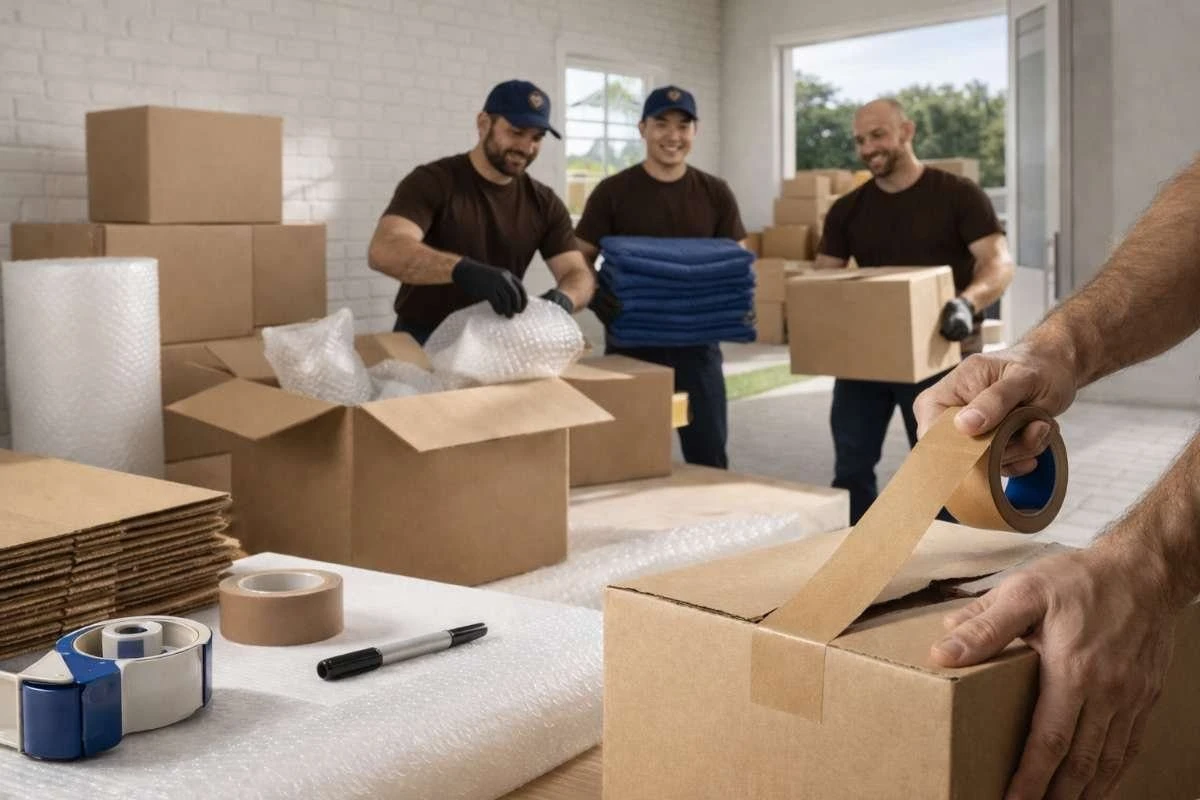
Packing is where most moves go wrong, and where most money gets wasted. Boxes that aren’t packed properly break down in transit. Mislabeled boxes end up in the wrong room. Items that aren’t wrapped correctly arrive damaged. These 25 tips come from the Smart Penny Moving® crew, based on years of packing homes across Cambridge, North Reading, Framingham, Woburn, and Greater Boston. Follow them and your move will go noticeably smoother.
Start early:
Begin packing with items you use less frequently and designate a specific room, like the garage or an extra bedroom, to store packed boxes.
Declutter before packing
Don’t pack things you don’t need. Go room by room and make three piles, keep, donate, discard. Every item you eliminate is one less thing to pack, carry, and unpack. For long-distance moves especially, less volume means a lower quote.
Get enough moving supplies
Running out of boxes halfway through is one of the most common causes of moving day chaos. Order more than you think you need, leftover boxes can be returned or recycled. We deliver boxes and supplies to your door in Greater Boston; order through our materials page.
Use proper moving boxes
Produce boxes, liquor store boxes, and random salvaged containers are inconsistent in size and strength. Use proper moving boxes, they stack cleanly, load efficiently, and are built to hold weight without collapsing. Our boxes are heavier duty than standard retail options.
Pack strategically
Pack room by room, not randomly. Mixing items from different rooms in the same box makes unpacking significantly harder. One room, one box, always. Label the destination room on every box before it gets sealed.
Create a packing station
Set up one area in your home with all your supplies, boxes, tape, markers, bubble wrap, packing paper. Having everything in one place means you’re not hunting for tape every time you seal a box. A packing station speeds up the whole process.
Reinforce box bottoms
Run tape along the bottom seam in an H-pattern before loading any box. A single strip of tape on the bottom fold is not enough for a heavy box, it will give way. Double-tape every box that will carry books, kitchen items, or anything with real weight.
Prepare a first-day box
Pack one clearly labeled box with everything you’ll need on day one at the new address, phone chargers, toiletries, a change of clothes, coffee, basic kitchen items, medications, and important documents. Load it last so it comes off the truck first. Keep it with you if possible.
Label boxes by room and contents
Write the destination room and a brief description on at least two sides of every box. “Kitchen, pots and pans” is more useful than just “Kitchen.” Include “FRAGILE” and “THIS SIDE UP” where needed. Boxes that are properly labeled get placed correctly the first time.
Plan box storage as you pack
Stack packed boxes in one designated room or area, ideally close to the exit. This keeps the rest of your home livable while you pack in stages, and makes loading the truck faster on moving day.
Protect fragile items properly
Wrap each fragile item individually in packing paper or bubble wrap before placing it in a box. Don’t just layer fragile items with paper in between, each piece needs its own wrapping. Fill gaps with crumpled paper so nothing shifts in transit.
Use gaps in boxes wisely
Stuff gaps with soft items, towels, socks, clothing, linens. This protects fragile items and means you’re not wasting space or buying extra bubble wrap. Every box should feel solid when you close it, nothing rattling, nothing shifting.
Don't overload boxes
Heavy items, books, tools, small appliances, go in small boxes. Light bulky items, pillows, bedding, lampshades, go in large boxes. A box so heavy it can’t be lifted safely is a back injury waiting to happen. The rule: if you can’t carry it comfortably, it’s too heavy.
Pack suitcases for the first few days
Treat your first few days at the new address like a short trip. Pack a suitcase with enough clothes, toiletries, and personal items to get through 2–3 days without unpacking boxes. You’ll be grateful you did when you’re too tired to unpack on moving night.
Keep tools accessible
Keep a basic toolkit out of boxes until the very end, screwdriver, Allen key, hammer, utility knife. You’ll need them for furniture disassembly before the move and reassembly after. Don’t pack them at the bottom of a box where you can’t get to them.
Involve the family
Assign age-appropriate packing tasks to everyone in the household. Kids can pack their own toys and books with supervision. Partners can handle specific rooms. Distributing the work makes the process faster and gives everyone ownership over their own belongings arriving safely.
Avoid non-standard containers
Laundry baskets, hampers, bins, and bags don’t stack, don’t load efficiently, and aren’t protected during transit. Everything that can go in a box should go in a box. Use non-standard containers only for items being transported in your car.
Use professionals for antiques and specialty items
Artwork, antiques, instruments, and high-value items require more than standard packing. Let us know in advance about any specialty pieces, we bring appropriate materials and handle them individually. Don’t try to wrap a painting in newspaper and hope for the best.
Photograph electronics before disconnecting
Take a photo of the back of your TV, computer setup, stereo system, and any other electronics before unplugging them. The photo shows you exactly where every cable goes when you’re setting things up at the new address. Takes 30 seconds and saves significant frustration.
Organize important documents separately
Passports, birth certificates, financial records, insurance documents, and medical records should travel with you, not in a box on the truck. Put them in a folder or bag that stays in your car throughout the move.
Prevent leaks from liquids
For toiletries, cleaning products, and any liquid containers, unscrew the cap, place a piece of plastic wrap over the opening, then screw the cap back on. Pack upright in a zip-lock bag for extra protection. One leaking bottle can ruin everything else in the box.
Pack valuables separately
Jewelry, cash, small collectibles, and sentimental items of high value should be packed separately and transported with you personally. These are the items that are hardest to replace if something goes wrong.
Mark essential boxes clearly
Beyond room labels, mark your most important boxes, first-day box, medications, kids’ essentials, with a bright colored marker or colored tape. When the truck is unloaded and there are 50 boxes in the new home, you’ll be able to find what you need immediately.
Do a full walkthrough before leaving
Before the truck pulls away, walk through every room, closet, cabinet, attic space, garage shelf, and outdoor storage area. Check under beds, inside appliances, and behind doors. Our crew does this as standard, but a second set of eyes never hurts.
Ask us to handle the packing
If this list feels overwhelming, that’s what our packing service is for. Full packing means our crew handles every room, properly, efficiently, and with the right materials for every item type. You focus on everything else that comes with a move. Get a quote that includes packing at 800-611-2201.
Print this list or save it to your phone and work through it in the weeks before your move. The tips that make the biggest difference are the ones you follow early, decluttering, getting the right supplies, and labeling properly from the start. When you’re ready to book, Smart Penny Moving® serves Cambridge, North Reading, Framingham, Woburn, and Greater Boston. Call 800-611-2201 or get a free quote online.
Whatever your move requires, we have a service for it
Your request has been received and a move specialist is reviewing your
information. We’ll contact you shortly regarding your move details
and availability.
For the most accurate quote, we recommend recording a quick video
walkthrough of the items you’ll be moving using the link below
— you can submit it anytime convenient for you:
📱 Self-Recording Inventory
NOTE: Check your junk and spam folders to ensure that you are not missing
any emails from us.
Client Testimonials
JZ
Joseph Zanca
Local Guide
Samuel, Walter, and Guiermo did a great job. Was very happy with how well they worked and how easy they made our move. Would highly recommend. Reasonable price for moving out of one house, storing overnight, and moving in the next day
ZB
Zac Broken Rope
We hired SmartPenny moving to help us move from our apartment in Brookline to a condo in Boston. Alberto was the absolute best, he was communicative, prompt, and took excellent care of all of our possessions. He was joined by Guillermo H, Melvin L, and Misael S who were truly all stars in moving our furniture both down stairs and then up roughly 60 steps to our new place. I couldn’t recommend them more strongly and will be sure to use them if we ever move again. Thank you!
TJ
Tom Jaques
Local Guide
Smart penny is fantastic. Friendly and fast, all you could ask for in a moving company. Our crew of Samuel, Guerrero, Walter, Eric were phenomenal. Couldn’t recommend enough!
WM
Wyatt Mufson
Local Guide
Amazing experience with Samuel, Melvin, and Alex! They did a great job, they were very thorough and careful with our stuff. They were right on time and finished much faster than I expected. They also packed up our entire kitchen and did a great job unpacking it too. Very impressive work!
LB
Leo Boudreau
Great group to work with. From Michael in the office and then the movers, great service every stage of the move. With all the snow, it was a challenge parking the truck and getting the furniture into the house. Samuel, Omar and Guillermo problem solved around each issue and got the job done. I would give Smart Penny Moving my highest recommendation. And I thought their prices were very reasonable.
LM
Lucy M
MAJOR MAJOR thank you to Samuel and Irvin!!! Not only were they super quick and helpful, but they were also incredibly kind and a joy to work with. They were both so careful my belongings, which means a great deal to me, you can’t say that about many movers. I’ve moved at least 3 times in the past 5 or so years and have only ever used Smart Penny, and I’ll continue to do so! Thanks again!
KI
Kenny Iannuzzi
This is my second time using Smart Penny Movers and I could not recommend them highly enough. They are very professional, very communicative and take great care of your things. Estuardo was the main mover and he was fantastic! They are also very up front with costs and very reasonable.
US
Urshila Sriram
Estuardo, Guillermo, and Alex were wonderful! They were lovely to work with and very efficient and professional. Completed our large 2-bedroom apartment move in ~3 hours, we couldn’t have done it without them. Would highly recommend to anyone looking for movers in the area!!
SS
Susan Stephenson
Smart Penny Moving delivered! Communication with Michael and Alan all through the process was great. I’m sure I called out of regular business hours a few times to change or clarify things, but it didn’t seem to bother them. The pick up was done by 3 guys within 6 hours. It was stunning to watch the speed and care they took packing 20 years of life and a 2 BR house into one truck. Estuado wrapped everything well and took special care of the special items. The delivery the other end was just as careful with Juan in charge. I felt a bit lazy being the ‘director’ and not lifting boxes, but the mover suggested (tactfully) that would make the process go quicker. Had I known my move would have been this smooth, I think I’d have relaxed before they arrived. THANK YOU!
AW
Alifa Watkins
Estuardo, Alex and Omar were the BEST movers I’ve ever had. They were patient, communicative, and went above and beyond to make sure everything was where we wanted it. Even when they didn’t even expect as big of a job as they walked in to, they were very graceful and were up to the task. 10/5!!!
EV
Emeric Viani
Outstanding experience. Quick quote for a small job to move a couch across town, cheapest of five companies I contacted. Final price ended up being $100 less due to how much time the job took. Both movers were exceedingly kind, prompt, and efficient. I would gladly use them again in the future.
LK
Leah Kosch
Alberto Alex Omar were fantastic. They moved our piano!! They were efficient, great with communication, and did a great job with our move. We’ve used Smart Penny twice now and would use them again.
AM
Andrew Malison-Reardon
Samuel, Omar, and Guillermo were fantastic movers. They were efficient, polite, and thoughtful when handling our belongings. I highly recommend using them for your move.
LF
Lucie feufeu
Estuardo was excellent, fast, and efficient. I was moved into my apartment quickly and everything was delivered safely without any damage. Would 100% recommend!
KW
Kaila Wilson Birchall
Our movers were excellent! They showed up a little early. They were very efficient with moving everything both in and out. They were quick to arrive at our house. Everything was handled with care. They were also very friendly! Great price, the company is very professional! Online system to figure out pricing was excellent! Would highly recommend.
CD
Charlotte Dobbs
We had a great move today with Samuel and his crew! They were so kind, helpful and strong! They took great care of our things and did a great job disassembling and reassembling some of our furniture. They really took care to make sure that we had an easy process of moving and getting settled in. We are so grateful!